Sunday, November 4, 2012

Sandy typhon update: Housing Nightmare Looms in Wake of Storm


According to The New York Times, New York City officials said on Sunday that they faced the daunting challenge of finding homes for as many as 40,000 people who were left homeless after the devastation of last week’s storm, a situation that the city’s mayor, Michael R. Bloomberg, compared to New Orleans’s after Hurricane Katrina.

Sandy typhon update: Housing Nightmare Looms in Wake of Storm
A northeaster may hit already battered coastal areas this week. Photo: Ruth Fremson/The New York Times

The mayor said that the 40,000 figure was the worst possible case given by the Department of Housing and Urban Development, and that a more realistic assessment was 20,000 people — most of them residents of public housing. Even in the best possible case, he said, the task will be formidable.

Sandy typhon update: Housing Nightmare Looms in Wake of Storm
Runners in New York City for the marathon volunteered instead. Photo: Michelle V. Agins/The New York Times

“We don’t have a lot of empty housing in this city,” Mr. Bloomberg said at a news conference on Sunday. “We are not going to let anybody go sleeping in the streets or go without blankets, but it’s a challenge, and we’re working on that as fast as we can.”

It is a task shared throughout the region, as officials in New York, New Jersey and Connecticut struggle to meet the demands of those whose homes have been left uninhabitable. In some cases, the solution may be a familiar, if unwelcome sight: the trailers provided by the Federal Emergency Management Agency after Hurricane Katrina.

Craig Fugate, director of the agency, said most displaced people would probably be housed in hotels or apartments. But in some regions, like Long Island with its many single-family homes and few large apartment blocks, he said there was a shortage of vacant housing.

“It has got to make sense for the neighborhood,” Mr. Fugate said, adding that it was up to the states to request the trailers. “We are going to bring all potential housing solutions and look at what works best for each neighborhood.”

Even as utility companies work to restore power to millions of customers, a northeaster, projected to land midweek, may hit the already battered coastal areas with heavy winds and strong waves that could cause more flooding and tear down power lines recently replaced and stop repair workers in their tracks.

“The first concern is slowing the army that we’ve got down; the second is more outages,” said John Miksad, Consolidated Edison’s senior vice president for electric operations. “It certainly does complicate the restoration.”

A week after Hurricane Sandy tore through the region, millions have regained electricity, mass transit is on the mend, and volunteers have rushed in to help. On Sunday, some runners who had expected to compete in the New York City Marathon, which was canceled, instead pitched in to haul fallen trees and to distribute clothing and food in the city’s most heavily damaged regions. Others ran a modified marathon route in Central Park.

In many regions, power is still lacking and fuel is nowhere to be found. As of Sunday, the number of utility customers without power was over 1.8 million, the Energy Department said; that included more than 900,000 in New Jersey, 280,000 served by the Long Island Power Authority and 198,000 Con Edison customers — nearly half of them in Westchester County. Gas shortages persisted with rationing imposed in New Jersey and lines at some gas stations stretching for miles.

And with recovery times in some areas projected to last months, a sense of desperation appeared to have set in. In parts of Staten Island, Long Island and coastal New Jersey, many still reside in dank, waterlogged houses and survive on food handouts from federal agencies and the National Guard.

FEMA announced over the weekend that it would begin providing free hotel rooms for up to two weeks to victims whose homes are not habitable, as authorities try to move people out of emergency shelters. Individuals must register with the agency to get the assistance, which also in some cases can include rental assistance for temporary apartments.

As of 3 p.m. Sunday, 182,000 residents of New York, New Jersey and Connecticut had applied for disaster assistance, and $158 million has been approved, he said. Some share of that total will need a temporary place to stay.

Word that some may have to leave their homes permanently caused further confusion and fear, particularly in public housing complexes heavily damaged by the storm.

At the Hammel Houses, a public housing complex in the Rockaways, saltwater stains from the storm surge were visible above first-floor windows, which like many in this part of New York City were all dark.

“They tell us we might evacuate,” said Gloria Evans, 47, who has lived at apartment 1B at the houses since she moved there 26 years ago as a new mother.

“Are they going to help us? They can’t just move everyone out and have no place to put them,” she said.

It is still uncertain how many people would ultimately need housing, temporary or otherwise. In New Jersey alone, over 5,000 people remain in shelters and tens of thousands who evacuated their homes now reside with relatives and friends. Those with no homes to return to will have to find a new place to live.

“We lost a lot of housing here in New Jersey,” Janet Napolitano, the Homeland Security secretary, said in Hoboken with Gov. Chris Christie. “We don’t even know yet which houses are reparable.”

In making his reference to Hurricane Katrina, Mr. Bloomberg said that to his recollection the number of displaced people in New York may have been similar to that in New Orleans. That estimation seemed inaccurate since several hundred thousand people were placed in federal housing in the months after that storm.

Officials were scrambling to prepare for the onset of cold weather. New York City has opened heating shelters and is passing out blankets to residents without electricity.

Temperatures throughout the region were expected to fall Sunday into the 30s, and the National Weather Service issued a freeze watch for parts of New Jersey, including the coast, the scene of some of the worst damage. Officials have urged residents across the region to head to shelters.

Volunteers were also trying to help. In the streets of Midland Beach, one of the hardest hit areas on Staten Island, they carried hoes, rakes, brooms and shovels as they went door to door offering their labor. Others circled the blocks in pickup trucks full of food, blankets, clothes and cleaning supplies. Impromptu distribution centers, piled high with food and clothes, sprung up on every other corner.

On Sunday morning, runners dressed in orange marathon gear crowded onto the Staten Island Ferry and headed to the storm-ravaged borough to help. They packed blankets, food, water and flashlights in shoulder bags. Some planned to run to battered areas once the ferry docked.

“There are people suffering on Staten Island, and we’ve got to do something about it,” said Neil Cohen, 42, from Riverdale in the Bronx.

On Sunday, gas lines seemed slightly shorter in some places than in the previous few days, but many stations were still closed. The authorities set up three fuel depots in New Jersey to provide doctors and nurses with up to 15 gallons apiece to allow them to get to work.

There were also concerns about drivers pumping more than their fair share of gasoline. Havier Nazario, 36, a principal at a Newark school who was at a station outside Newark Liberty International Airport, said he saw a man buy $101 worth of gas.

“I don’t know what he’s trying to power, but I think folks should pretty much just take what they need for their vehicle; otherwise the ration doesn’t have its effect,” he said.

The gas crisis in the New York metropolitan area appeared to be easing, according to information released late Sunday by the Energy Department. As of Sunday, only 27 percent of stations in the region reported to be out of fuel, down from 67 percent on Friday.

Gov. Andrew M. Cuomo said in a news conference that tankers and barges were on the way to ease shortages. The Port Authority of New York and New Jersey announced that Port Elizabeth, N.J., reopened on Sunday to receive its first shipments. Other Port Authority seaports remained closed.

“We do believe it is a short-term problem,” Mr. Cuomo said, adding that shortages could continue for several days.

As for the subways, all of the numbered lines were running to some degree, said Joseph J. Lhota, the chairman of the Metropolitan Transportation Authority. The No. 1 train has been extended south to 14th Street, and transit officials said they hoped that it would reach Rector Street by Monday. On Sunday evening, Mr. Lhota announced that Q train service had been partially restored to Kings Highway.

The South Ferry station, although the water has been pumped out, remains unusable. The L train from Brooklyn to Manhattan and the G train from Brooklyn to Queens also remain suspended with no estimated time for resuming service.

Mr. Lhota said trains would arrive at stations less often on Monday than on a normal weekday. “It’s an old system,” Mr. Lhota said in televised remarks. “It needs tender loving care, and it just had a major accident.”

Monday morning would also bring another change: the return to school of nearly a million children. About 96 percent of the city’s school buses are expected to be operating, and a vast majority of schools should be open, Mr. Bloomberg said. Students at closed schools will be sent to other locations, though the mayor said that keeping everyone informed about who goes where was proving difficult. The city has made over a million robocalls to parents and has purchased full-page advertisements in Monday’s newspapers with information about scheduling changes.

Mr. Bloomberg also set the stage for possible confusion at polling places during the election on Tuesday. About 143,000 voters in the city will be assigned to sites outside their districts, and the mayor expressed hope that the New York Board of Elections, which he has criticized for mismanagement, would be prepared.

Asked whether he thought the board was up to the task, he replied: “I have absolutely no idea.”

These are some photos were posted on The New York Times:

Sandy typhon update: Housing Nightmare Looms in Wake of Storm

Officials have urged residents without heat to head to shelters. Michael Appleton for The New York Times

Sandy typhon update: Housing Nightmare Looms in Wake of Storm

In many areas, power is still lacking and fuel nowhere to be found. Peter Foley/European Pressphoto Agency

Sandy typhon update: Housing Nightmare Looms in Wake of Storm

FEMA said it would offer housing to those who could not go home. Marcus Yam for The New York Times

Sandy typhon update: Housing Nightmare Looms in Wake of Storm

Cary Press stood by his gas stove for warmth in Long Beach, N.Y. Marcus Yam for The New York Times.

Sandy typhon update: Housing Nightmare Looms in Wake of Storm

It was uncertain how many people would ultimately need housing. Robert Stolarik for The New York Times

Sandy typhon update: Housing Nightmare Looms in Wake of Storm

Residents and volunteers throughout the region were cleaning up. Tom Mihalek/Reuters

Sandy typhon update: Housing Nightmare Looms in Wake of Storm

New York City has opened shelters and is passing out blankets. Adrees Latif/Reuters

Sandy typhon update: Housing Nightmare Looms in Wake of Storm

In parts of Staten Island, many still reside in waterlogged houses. Seth Wenig/Associated Press

Reporting was contributed by Michael M. Grynbaum, Mary Pilon, Eric Lipton, Steve Eder, Vivian Yee and Thomas Kaplan.

According to New York Times

Friday, November 2, 2012

Super typhoon Sandy in Photos


These photos express every thing we can say about the super typhoon Sandy, the "monster" which made so many pain for us... This the part 1 of the series of pictures about Sandy which I collected in the internet. View them, but remember to pray for the victims..

A house floats in the bay after it was washed from its foundation during Hurricane Sandy in Manotoloking, New Jersey on October 31. The U.S. Northeast began an arduous slog back to normal on Wednesday after historic monster storm Sandy crippled transportation, knocked out power for millions and killed at least 64 people with a massive storm surge that caused epic flooding.

Joseph Leader, Metropolitan Tranportation Authority Vice President and Chief Maintenance Officer, shines a flashlight on standing water inside the South Ferry 1 train station in New York City on Oct. 31 in the wake of superstorm Sandy. The floodwaters that poured into New York's deepest subway tunnels may pose the biggest obstacle to the city's recovery from the worst natural disaster in the transit system's 108-year history.

People wait to use a pay phone on Bright Beach Avenue, on Wednesday in the Brooklyn borough of New York. 

People crowd into a Chase Bank ATM kiosk to charge phones and laptops at 40th Street and 3rd Avenue, one block north of where power has gone out, on Wednesday, in New York City. "This is the modern campfire," one man said. 

A people shop for food piled into shopping carts on Brighton Beach Avenue, on Wednesday in the Brooklyn borough of New York. 

Renter Donna McBride reacts to seeing the damage done to her home by the storm surge of Hurricane Sandy in Lindenhurst, New York, on Wednesday. 

A man walks past the remains of a building near a damaged section of boardwalk in the wake of superstorm Sandy, on Wednesday in Atlantic City, N.J. 

Hoboken residents navigate the floodwaters from Hurricane Sandy as they emerge from their apartments, and in some cases return to remove valuables, on Wednesday in Hoboken, NJ. 

A dog named Shaggy is handed from a National Guard truck to National Guard personnel after the dog and his owner left a flooded building in Hoboken, N.J., on Wednesday. 

Workers try to clear boats and debris from the New Jersey Transit's Morgan draw bridge on Wednesday in South Amboy, N.J., after Monday's storm surge from Sandy pushed boats and cargo containers onto the train tracks. 

Rey Erney, right, plugs his phone in on a neighbor's front steps in Hoboken, NJ. "We don't know anything. It's very difficult to get information from the police or fire department. PSEG doesn't even have power at their own location yet." Even though he doesn't know them he says "We have the best neighbors, it's very generous of them to let us charge." 

Men dig trenches for water being pumped out of flooded basements on October 31 in Long Beach, New York.The storm has claimed many lives in the United States and has caused massive flooding across much of the Atlantic seaboard. U.S. President Barack Obama has declared the situation a 'major disaster' for large areas of the U.S. east coast, including New York City, with widespread power outages and significant flooding in parts of the city. 

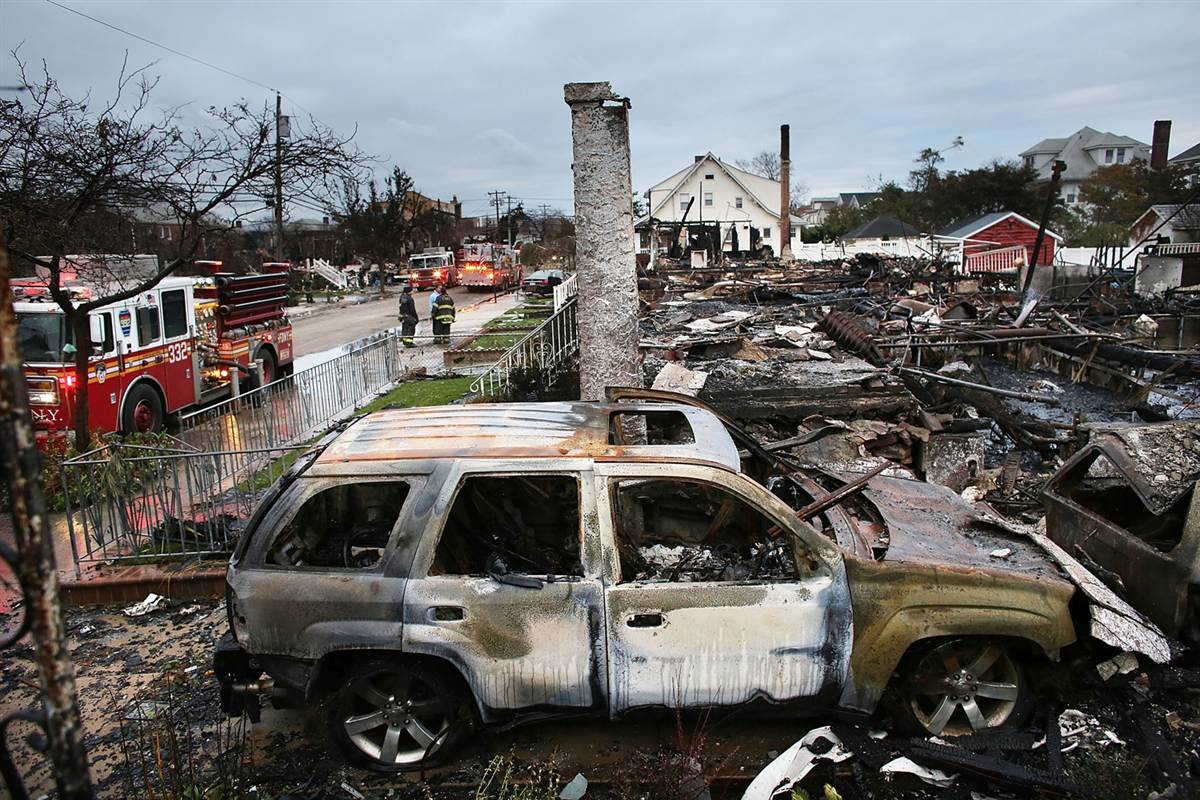
The remains of homes burned down in the Rockaways during Superstorm Sandy are viewed on Wednesday in Queens, New York. 

Two secret service members scan the area as US President Barack Obama visits a neighborhood on October 31 in Brigantine, New Jersey. Americans sifted through the wreckage of superstorm Sandy on Wednesday as millions remained without power. The storm carved a trail of devastation across New York City and New Jersey, killing dozens of people in several states, swamping miles of coastline, and throwing the tied-up White House race into disarray just days before the vote. 

A vehicle is seen submerged in a pit of water beside other debris following Hurricane Sandy, in Seaside Heights, New Jersey on October 31. 

Pedestrians pass by a tree that was destroyed by Hurricane Sandy in Washington on October 31. The U.S. Northeast began an arduous slog back to normal on Wednesday after historic storm Sandy crippled transportation, knocked out power for millions and killed at least 64 people with a massive storm surge that caused epic flooding. 

Damage is viewed in the Rockaway neighborhood where the historic boardwalk was washed away during Hurricane Sandy, on Wednesday, Oct. 31, in the Queens borough of New York City. 

Freddie Nocella, Jr., left, hands a vase to his grandfather Bill Schmith, as Schmith works to salvage belongings from his heavily damaged home in the aftermath of superstorm Sandy, on Wednesday in Babylon Village, N.Y. 

A car that was washed in from Hurricane Sandy is buried in sand that on Wednesday in Long Beach Island, New Jersey.

According to msn.com

Thursday, November 1, 2012

Here we go again, rumors suggest Microsoft has begun testing and building the so-called Surface Phone


Concept design of what a “Surface Phone” might look like.

Microsoft isn’t a software company, its a hardware and services company too. Microsoft’s Steve Ballmer has made this abundantly clear in recent times not only by saying as much, but also by their actions with the release of the Microsoft Surface and the continued success of the Microsoft Xbox line.
While Onuora has been saying for a long time now that Microsoft will get in the smartphone game, Microsoft still has yet to confirm such a move. That being said, the Wall Street Journal now reports that suppliers in Asia have confirmed that Microsoft is in fact testing a phone— though not surprisingly these folks are wishing to stay anonymous.
So what is Microsoft developing? While the details are scarce we do know the phone will have a screen size between 4 and 5-inches, nothing particularly revolutionary or new in that fact.
Again, even the anonymous sources talking about the so-called Surface phone aren’t clear whether or not this is just a test or if Microsoft is truly serious about mass producing a smartphone. I wouldn’t be surprised if Microsoft is just testing a few different designs for IF/when they launch the Surface phone in the future… that doesn’t mean what they are developing now will turn into the final product.

Microsoft Surface Phone – Good idea or not?

The Surface has attracted massive lines and has been praised heavily for pushing Windows tablet design standards to a whole new level. It has also somewhat come under attack by Microsoft’s partners for potentially eating up marketshare that originally went to companies like HP, Dell, Acer and Samsung.
We’ve already discussed the reasons why Microsoft went into the hardware game with the Surface in the past. One of the reasons in my opinion is that none of their partners had yet shown anything that was truly “out of the box” when it came to design thought.
After the announcement of the Surface, more and more vendors started making cool and unique looking tablets and hybrids. It forced Windows partners to step up their game.
That being said, Nokia’s game is already pretty stepped up. The Lumia 920 and 820 lines are both quite attractive— though their slightly oversized design approach won’t appeal to everyone. Even HTC seems to be putting out hardware that is sexy and of high-build quality.
The only partner that hasn’t thought outside the box with phones much would be Samsung. I like the new ATIV smartphone but let’s be honest, it doesn’t look much different than what you’d get with any of their Android smartphone offerings.
Of course that could be a good think for an Android/Samsung fan thinking about making the switch to Windows Phone.
If Nokia continues to fall behind and struggle, the Surface phone will come, that much you can bet on. Nokia might have GREAT hardware and software designing abilities but they just aren’t that popular in the United States and are losing ground in other parts of the world as well.
Like Nokia’s own CEO said, a Surface Phone would boast the Windows Phone ecosystem.
I also suspect that a Surface Phone would kill off Windows Phone partner sales in a big way. The main reason that this doesn’t happen with the Surface RT is that it might be a tablet with a dock, but there are still things it can’t do that other hybrids, tablets and laptops can— there just seems to be more room for this kind of competition in the tablet world, at least in my opinion.
I could certainly be 100 percent wrong though.
Do you want a Microsoft Surface Phone or are you perfectly happy with with HTC, Samsung, Nokia and other partners are producing so far?

Friday, October 26, 2012

Kaspersky Internet Security & Kaspersky Anti-Virus 2013 v13.0.1.4190 Final + Keys


Kaspersky Internet Security & Kaspersky Anti-Virus 2013 v13.0.1.4190 Final + Keys


Kaspersky Internet Security & Kaspersky Anti-Virus 2013 v13.0.1.4190 Final + Keys | 305 MB


New in protection:
· The Sandbox technology, which uses virtualization methods to create a safe environment for running applications (Safe Run for Applications), has been significantly improved. The application now features the option to run suspicious applications on a dedicated virtual desktop, which ensures reliable protection of the operating system. Safe Run for Websites (safe browser), which protects data being entered by the user, has been implemented to allow handling websites that require entering confidential information.


The scope of the Web Anti Virus component has been expanded thanks to the new modules that had been added:
· Online Banking identifies banking websites and allows the user to switch to Safe Run for Websites, which has been designed to handle this sort of web resources.
· Safe Surf consists of previously implemented Kaspersky URL Advisor enhanced with a new mode of blocking websites with high threat rating calculated by Kaspersky Lab.

Kaspersky Internet Security 2013 introduces the following new features:
· For the safe operation of services of Internet banking and payment systems, as well as make purchases at online stores added to Secure Payment.
· To protect the personal information entered at web sites, from keyloggers added protection of data entry with a hardware keyboard.
· To protect against malicious use of software vulnerabilities in the component activity monitoring feature added protection from exploits.
· Added the ability to automatically install the latest version of Kaspersky Internet Security 2013, containing the latest updates databases. Automatic installation of the program is done using special tools for installation, available for download from the Internet.
· Added the ability to turn control of secure connections using Parental Control.
· Added the ability to automatically prevent an active infection, preventing the installation of Kaspersky Internet Security 2013 on your computer.
Improved:
· Improved Parental Control feature: Added ability to update the rules for checking Web sites by category in the database updates. This allows more control over childrens access to websites with inappropriate content.
· Reduced impact of the program on the performance of the operating system and reduced use of computer resources. In particular, the reduced impact of the program at boot time and application launch.
· Protection against hidden malware installed on your system and steal personal data.
· Improved functionality of the virtual keyboard: now you can open the virtual keyboard using the shortcut icon that appears in the data entry fields on websites.
· Improved heuristic analysis is performed for checking Web sites for signs of phishing.
· Improved functionality of the Anti Spam, which provides a more secure filtering of junk mail.
· Reduced the size of the database program that allows you to reduce the amount of downloaded data and to accelerate the installation of updates.
· Optimized the appearance of the main window for quick and easy access to major functions and components.
· Optimized the ability to control the basic functions of the program from the keyboard.
· Improved use of technology risk rating programs to protect your computer and personal data, based on analysis of program behavior from other users of the products Kaspersky Lab.
· The list of the supported versions of web browsers.

Kaspersky Internet Security 2013 delivers premium PC protection from all Internet threats. Industry leading technologies, such as Safe Money and Secure Keyboard, ensure youre always safe as you bank, shop, surf, social network, and more. Plus, optimized performance technologies allow you to enjoy the Internet to its full potential without slowing you down.
Kaspersky Anti Virus 2013 brings you the essential antivirus technologies that your PC needs – in a product thats easy to download, install and run. Kaspersky Anti Virus 2013 works behind the scenes – defending you and your PC against viruses, spyware, Trojans, rootkits and other threats all without significant impact on your PCs performance.

Benefits
Protects against all known viruses
Detects new, emerging and unknown threats
Identifies suspicious websites and phishing websites
Prevents malware from exploiting vulnerabilities in your PC
Automatic download and installation features save you time and effort

Key Features
· System Watcher
· Improved! Better anti phishing protection
· New! Automatic Exploit Prevention
· Improved! Minimal impact on PC performance for a range of usage scenarios
· Improved! Optimized antivirus databases
· New! Reduced Battery Drain
· Improved! Easy to use interface
· Virtual Keyboard

Operating Systems:
· Windows XP
· Vista
· Windows-7
· Windows 8
Download:

Mirror 1:

Mirror 2: